April 16, 2024
Triggered by the challenges at the Boeing Company, a risk executive and her leadership team use insurance strategically to allay her firm’s customers’ new fears of quality and safety.

Triggered by the challenges at the Boeing Company, a risk executive and her leadership team use insurance strategically to allay her firm’s customers’ new fears of quality and safety.
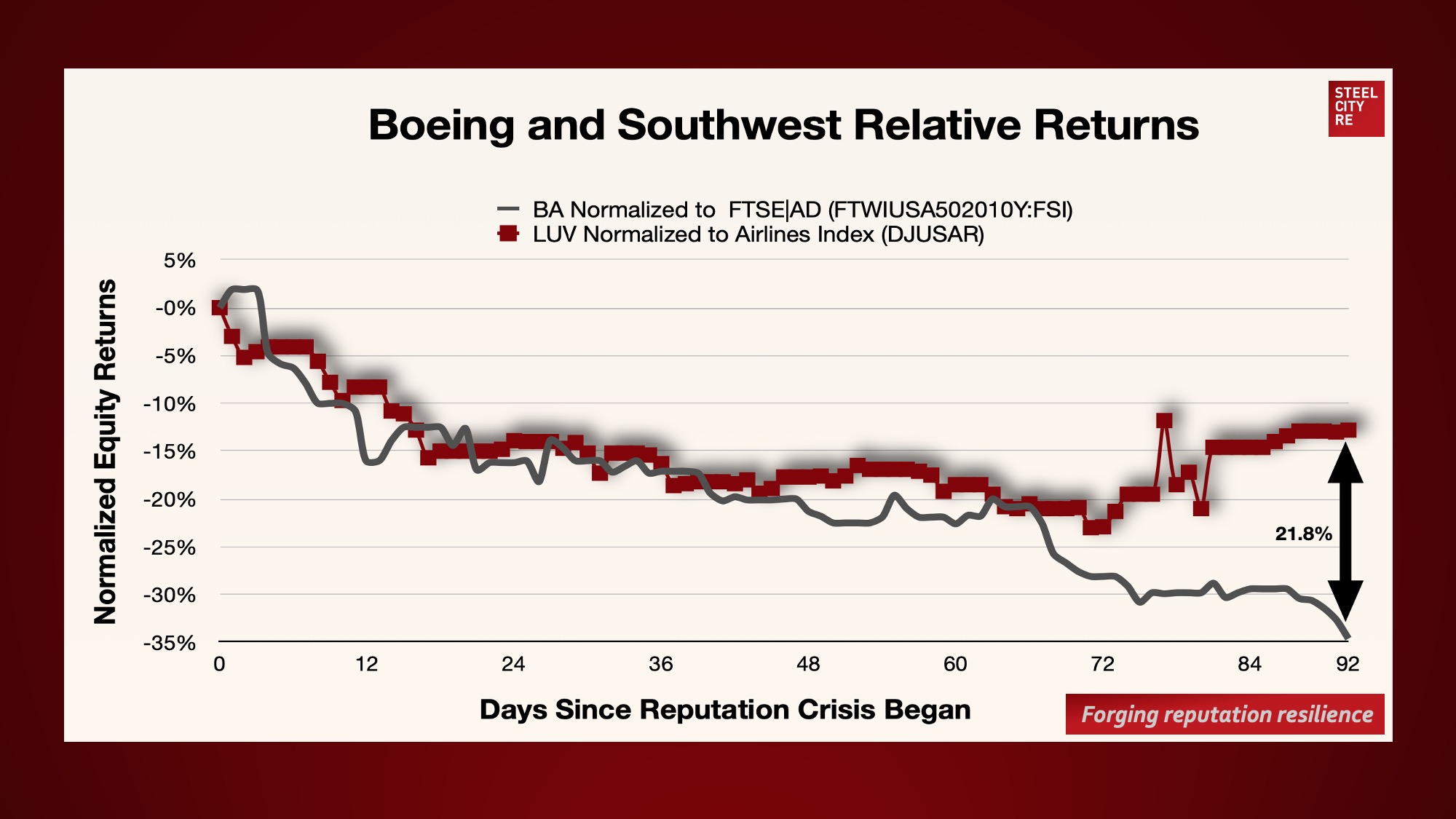
It’s the end of a miserable quarter as Boeing Company’s reputation crisis hits day 92. Equity is down 35% to peers: 22% worse than Southwest Airline’s 13% day 92 under performance.
![Exec Chair Misconduct Allegations […] TKO saw a "massive reputation value drop," according to Steel City Re's Resilience Monitor.](https://steelcityre.com/wp-content/uploads/2024/03/20240320-agenda-TKO-director-independence-mcMahon-Steel-City-Re.jpg)
Exec Chair Misconduct Allegations […] TKO saw a “massive reputation value drop,” according to Steel City Re’s Resilience Monitor.
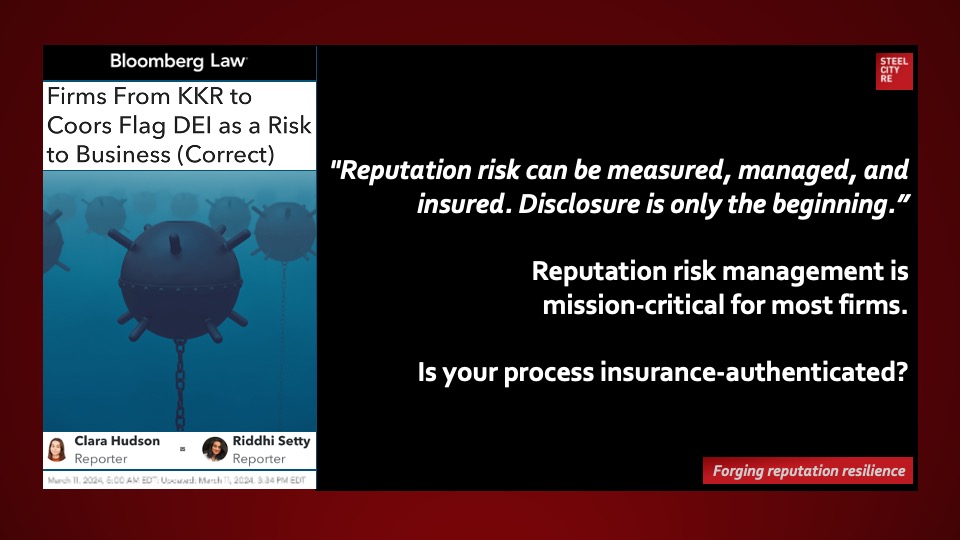
A “flurry of securities filings noting potential legal and reputation risks stemming from diversity, equity and inclusion efforts follows the US Supreme Court’s June decision .” […] “If we do not successfully manage expectations across these varied stakeholder interests, it could erode stakeholder trust, impact our reputation, and/or constrain our investment and fundraising opportunities,” one filing said.
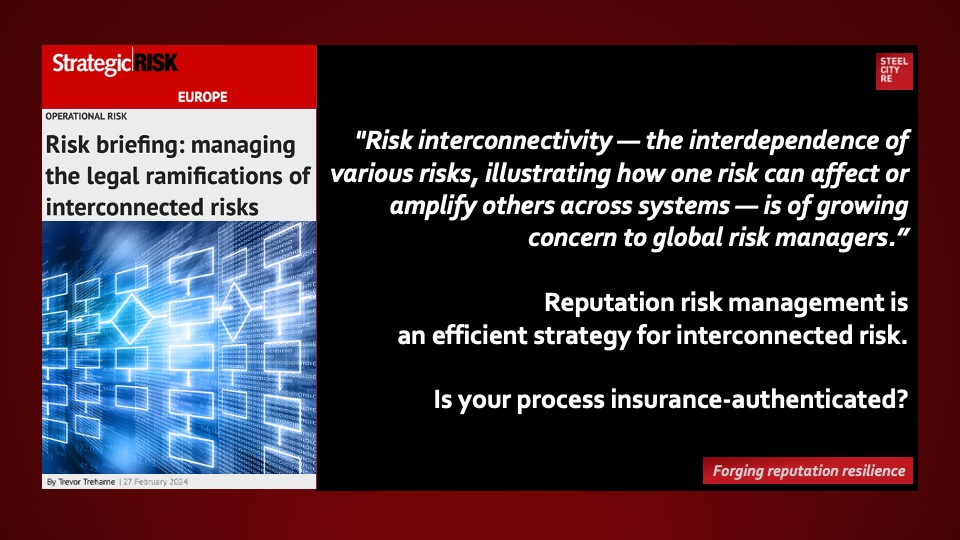
Reputation risk management is an efficient strategy for interconnected risk. “Risk interconnectivity — the interdependence of various risks, illustrating how one risk can affect or amplify others across systems — is of growing concern to global risk managers. […] Andrew Chung, litigation, arbitration and investigations partner at Linklaters, said the key enterprise risks that are top of mind for clients today are interconnected. He explained: “We are seeing how risks across financial crime, cyber, ESG and energy transition, digital transformation and AI, and geopolitics including supply chain and sanctions all have common elements and data, so now require an enterprise-wide and holistic lens more than ever, to properly manage the risks.”
Three vignettes of risk managers gallantly using Steel City Re’s reputation risk solutions to forge enterprise resilience.
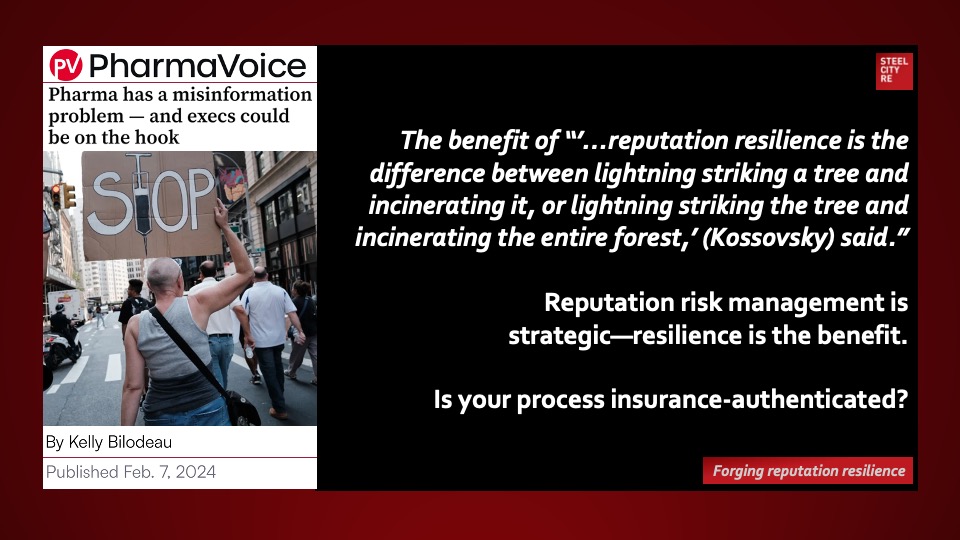
Pharma has a misinformation problem — and execs could be on the hook. While vaccine-related misinformation is prevalent, it’s not the only threat. False information can arise around ethics, innovation or safety, and threaten a pharmaceutical firm’s reputation, viability and profitability. Reducing the damage from these threats requires a proactive approach. […] Kossovsky agrees.
![Nir Kossovsky, CEO of Steel City Re, an insurance provider for reputational risk, said his firm’s Reputation Resilience Monitor for Tesla indicated little concern about Musk’s pay package, but real concern about the firm’s cost of operations, declining net income and future prospects. […] “However, should stakeholders become excitable, then any incident — even another round on the pay package — could trigger a shift in their expectations from fandom-level support to anger and disappointment,” he said.](https://steelcityre.com/wp-content/uploads/2024/02/20240205-Tesla-Musk-Pay-Package-Reputation-Steel-City-Re.jpg)
Nir Kossovsky, CEO of Steel City Re, an insurance provider for reputational risk, said his firm’s Reputation Resilience Monitor for Tesla indicated little concern about Musk’s pay package, but real concern about the firm’s cost of operations, declining net income and future prospects. […] “However, should stakeholders become excitable, then any incident — even another round on the pay package — could trigger a shift in their expectations from fandom-level support to anger and disappointment,” he said.
Forty years after a tsunami of lawsuits demanded action for the risks of D&O liability, history is rhyming with the risks of D&O culpability. Here are the top 3: Risk governance, ESG strategy, and C-suite experience.
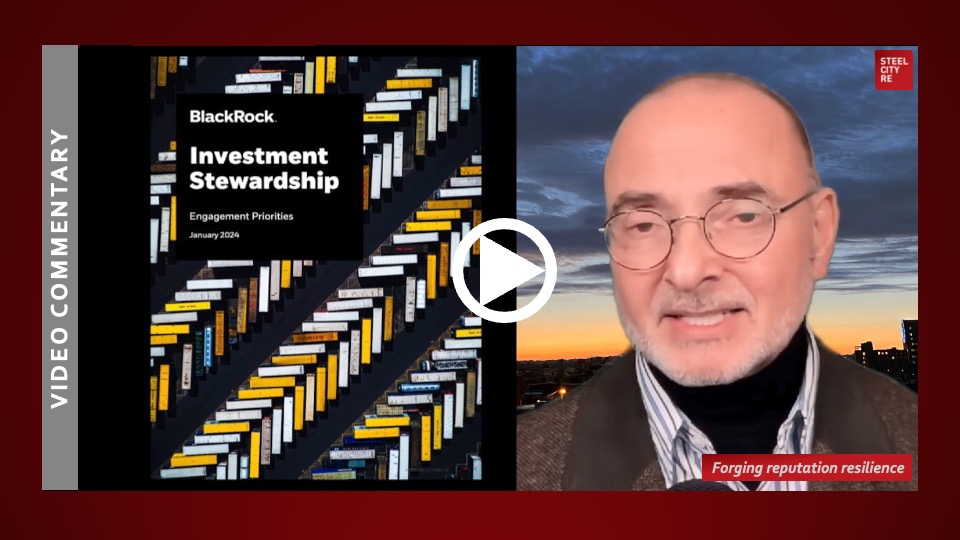
$5 trillion worth of shareholder votes want more ERM this year. The investment stewardship team at Blackrock, the world’s largest asset manager, will put “increased focus on how companies are strengthening financial resilience.” It is a is a challenge Steel City Re has been anticipating since 2007.