April 5, 2024
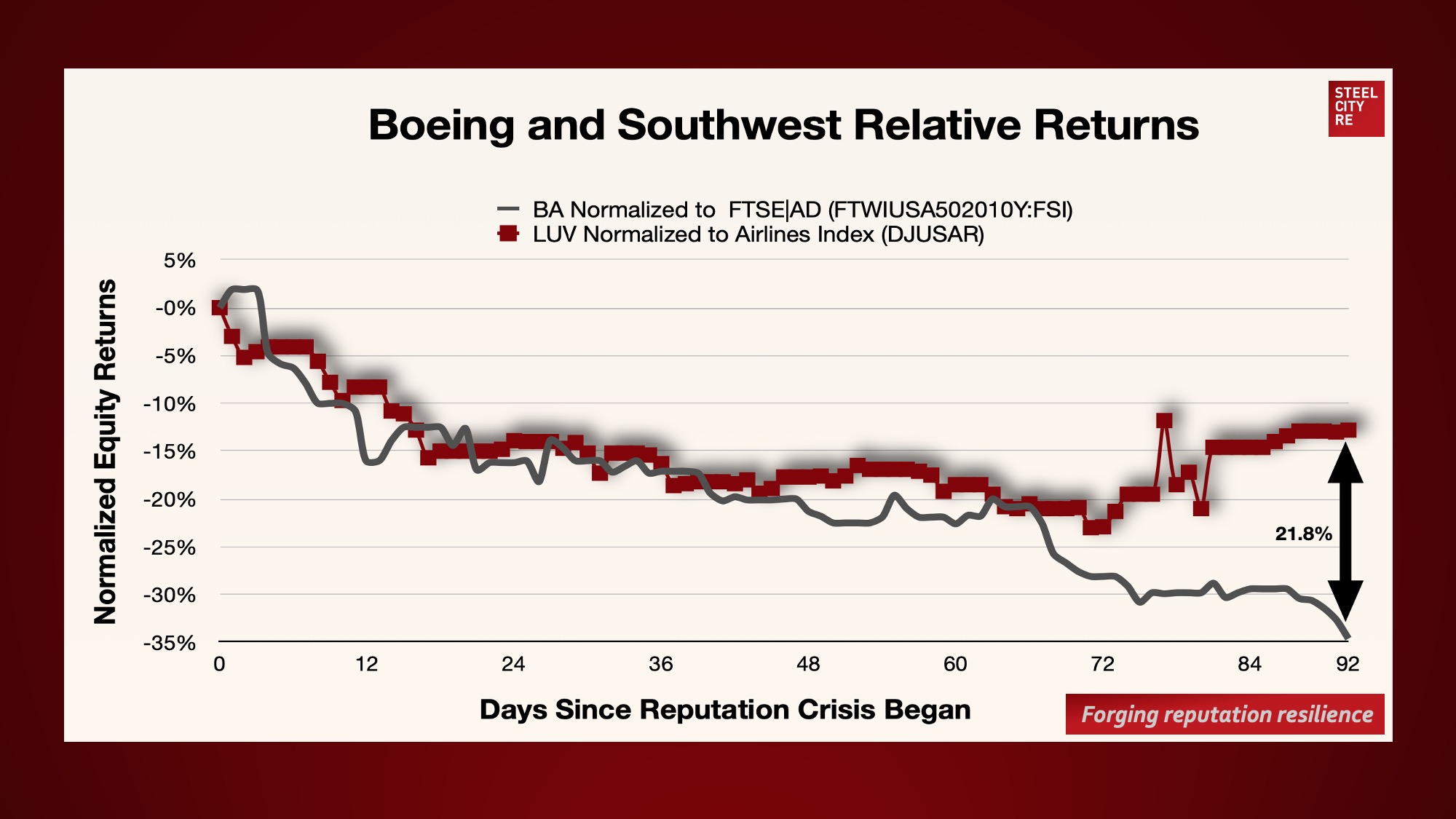
It’s the end of a miserable quarter as Boeing Company’s reputation crisis hits day 92. Equity is down 35% to peers: 22% worse than Southwest Airline’s 13% day 92 under performance.

It’s the end of a miserable quarter as Boeing Company’s reputation crisis hits day 92. Equity is down 35% to peers: 22% worse than Southwest Airline’s 13% day 92 under performance.
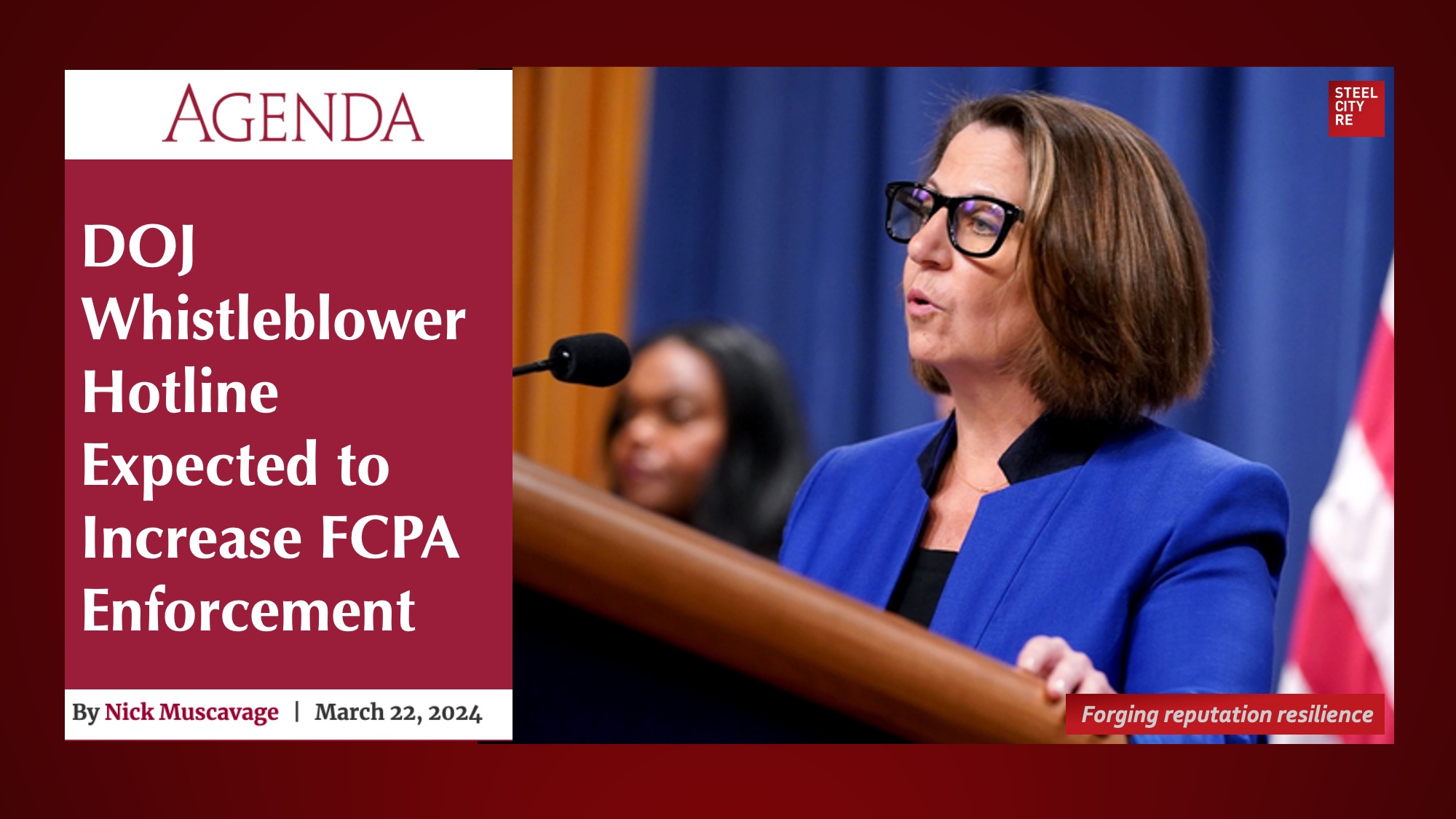
The new program “will create new incentives for individuals to report misconduct,” “If anything (said a defense lawyer), I think you’re going to see more scrutiny on this, […] And the risks are increasing.” The increased risk of discovering an adverse event is not unlike placing an additional bullet in the chamber in a game of Russian Roulette. But with risks increasing to all companies, and risk being the basis for discounting value, all companies will be equally discounted. That will be hard to appreciate in a stock market that is soaring. Until it isn’t. That’s where we come in. With reputation risk forecasting, management, and insurance, Steel City Re helps companies build and prove to stakeholders their thoughtful risk management and dutiful governance over all that is mission-critical. It is an authenticated story stakeholders can appreciate and value.
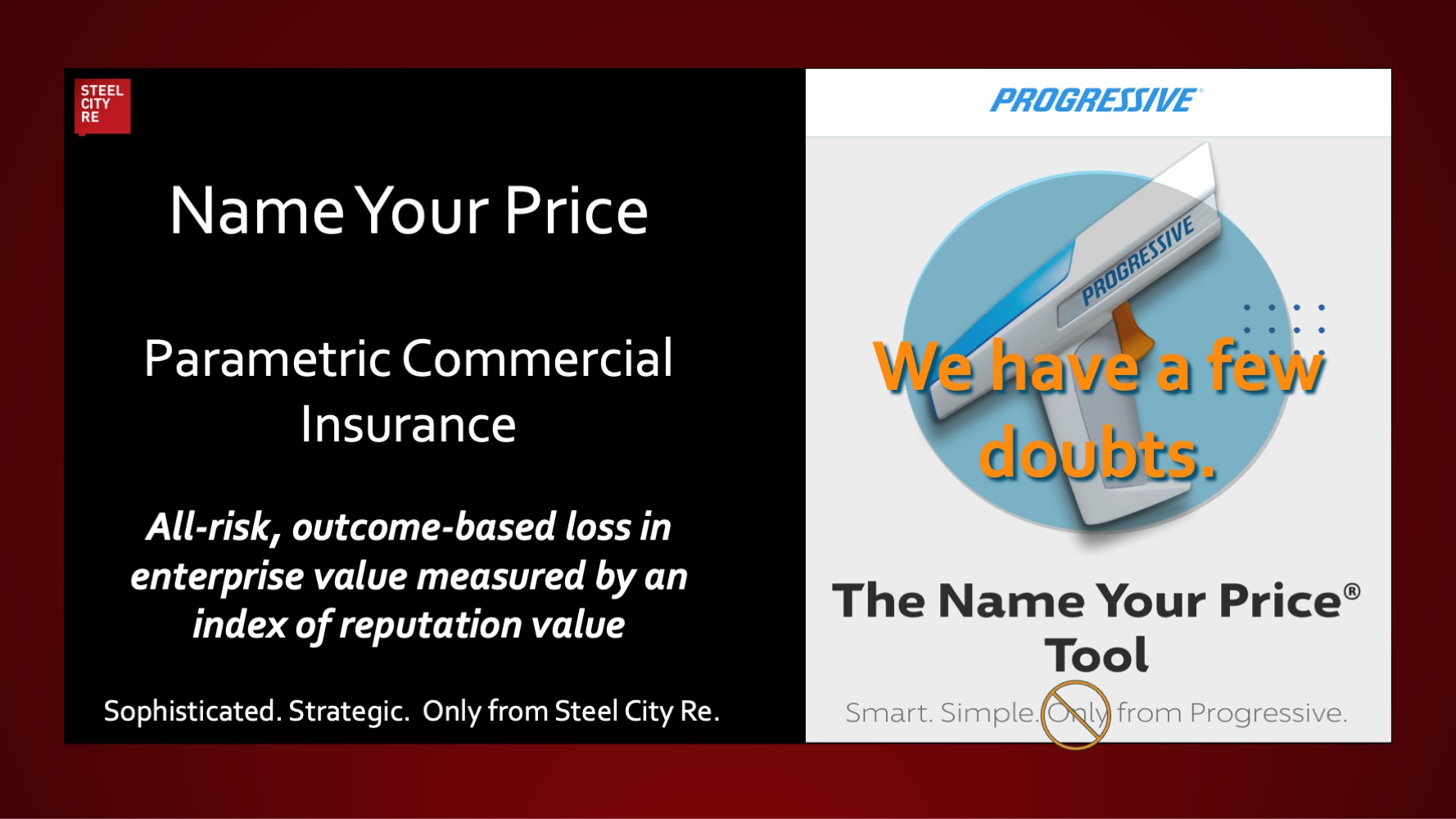
Parametric commercial insurance: name your price. All-risk, outcome-based loss in enterprise value measured by an index of reputation value.
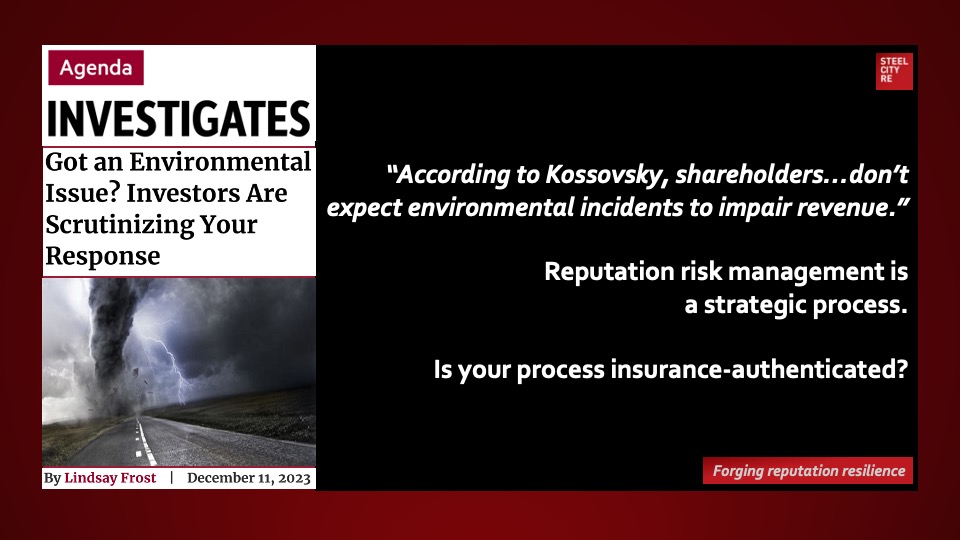
Environmental issue? Investors scrutinizing! According to Kossovsky, shareholders seem most concerned about the impact of fines and other costs, but, in the long run, usually don’t expect environmental incidents to materially impair revenue.
![“Over the course of four days at NACD Summit 2023, speakers pushed nearly 1,500 in-person and virtual attendees to think about new approaches and ways of thinking about their roles as directors in a world of crisis. […] One area that is an emerging risk in today’s environment is a company’s reputation. ‘We failed to predict that trust could be a target, just like information systems, and that there are entities out there that want you to diminish trust in our institutions…’”](https://steelcityre.com/wp-content/uploads/2023/11/20231122b-Steel-City-Re-1.jpg)
“Over the course of four days at NACD Summit 2023, speakers pushed nearly 1,500 in-person and virtual attendees to think about new approaches and ways of thinking about their roles as directors in a world of crisis. […] One area that is an emerging risk in today’s environment is a company’s reputation. ‘We failed to predict that trust could be a target, just like information systems, and that there are entities out there that want you to diminish trust in our institutions…’”
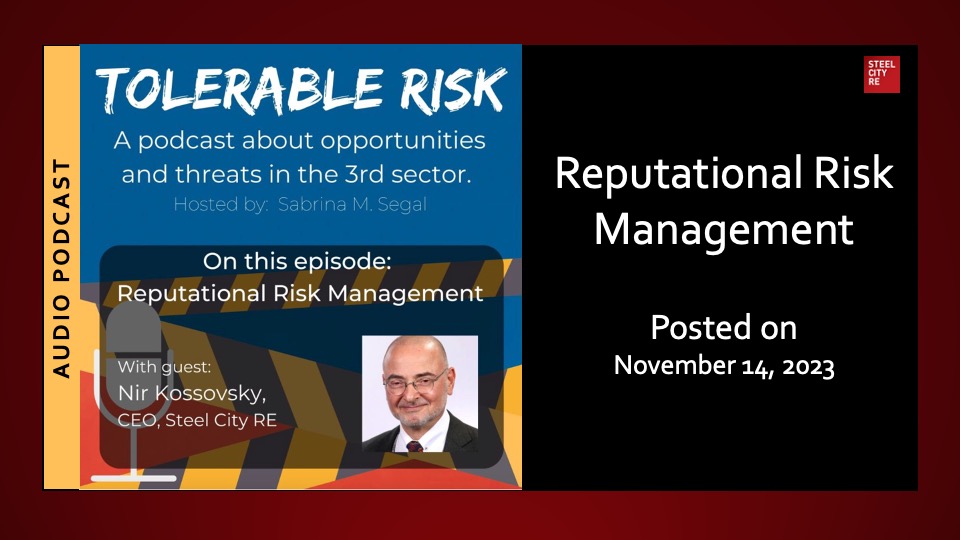
Tolerable Risk podcast. 🔊 My guest is Nir Kossovsky, CEO of Steel City Re and an expert in the area of reputational risk management. Nir has the most interesting background which gives him multiple perspectives on the topic of reputational risk.
During the episode, Nir and I discuss:
👀 What “agitation” and “behavior perils” are and why you should be aware of them
🤔 Why perception is as important (if not more!) than reality
💰 How taking an active approach to reputational risk management can help you with fundraising
🦁 And how it all starts with courage
✅ Nir also discusses how the “Big Six” – Ethics, Innovation, Safety, Security, Sustainability, and Quality – are the best place to begin.
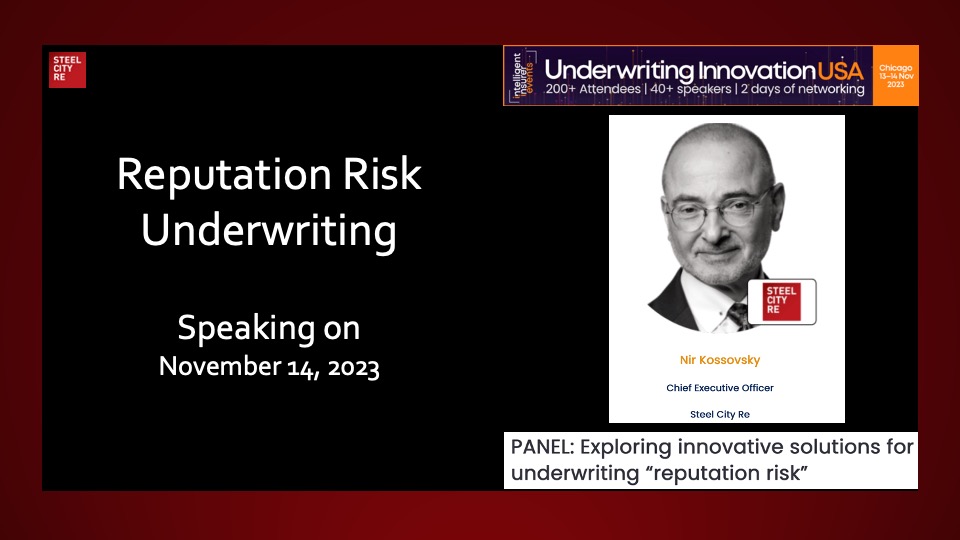
Chicago, 13-13 2-23. Innovative solutions for underwriting “reputation risk; e.g., parametric modeling of enterprise value impairment for an outcome trigger.
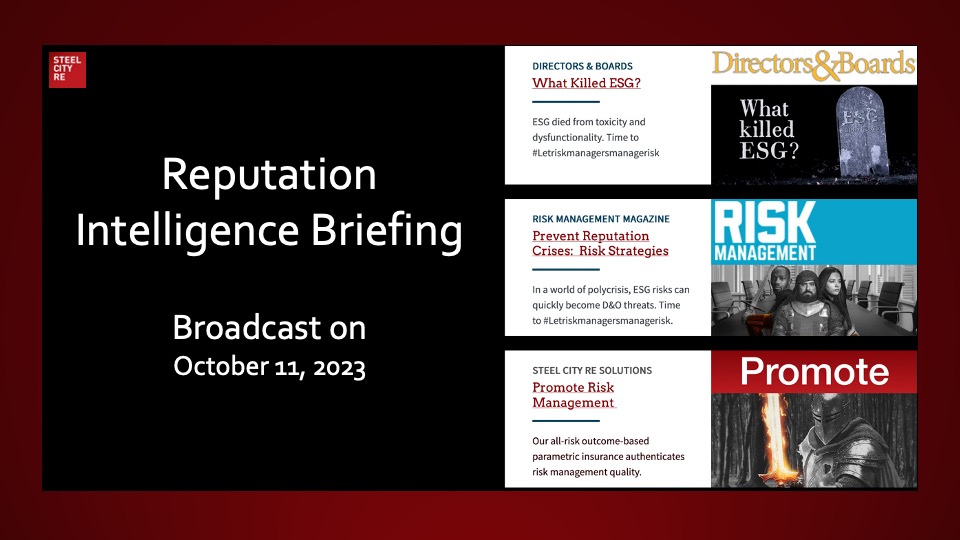
Steel City Re CEO and former Los Angeles County deputy coroner on what derailed the ESG movement & what boards expect from risk management in the aftermath.
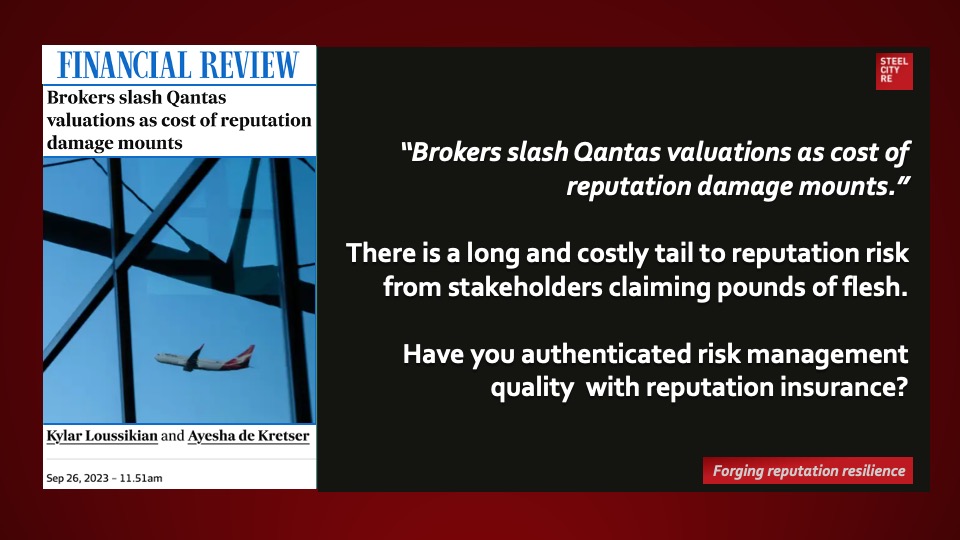
Qantas cost of reputation damage mount There is a long, costly tail to reputation risk from stakeholders claiming pounds of flesh.
![In a world of polycrisis, […] risk managers need to… market the elevated quality of their risk management processes.](https://steelcityre.com/wp-content/uploads/2023/09/20230926-Steel-City-Re.jpg)
In a world of polycrisis, […] risk managers need to… market the elevated quality of their risk management processes. The author thanks for their contributions to this article:
Courtney Davis Curtis, University of Chicago; Deyna Feng, Cummins, Inc.; Mary C. Friedl, Redbox; Kathleen A. Graham, The HQ Companies; Chris Hammond, Stepan; Enya He, Blu Clarity PBC; Carnell R. Jones, Trinitas Ventures; Christy Kaufman, Zillow Group; John C. Kline, Discover Financial Services; Manuel Padilla, MacAndrews & Forbes Incorporated; Soubhagya Parija, FirstEnergy and New York Power Authority; Kristen Peed, CBIZ; Theresa Severson, Kite Realty Group; Seung Yoo, Regal Rexnord Corporation; and Denise Williamee, Steel City Re.