CFOs

September 10, 2025

Personal attacks on directors are now a governance weapon

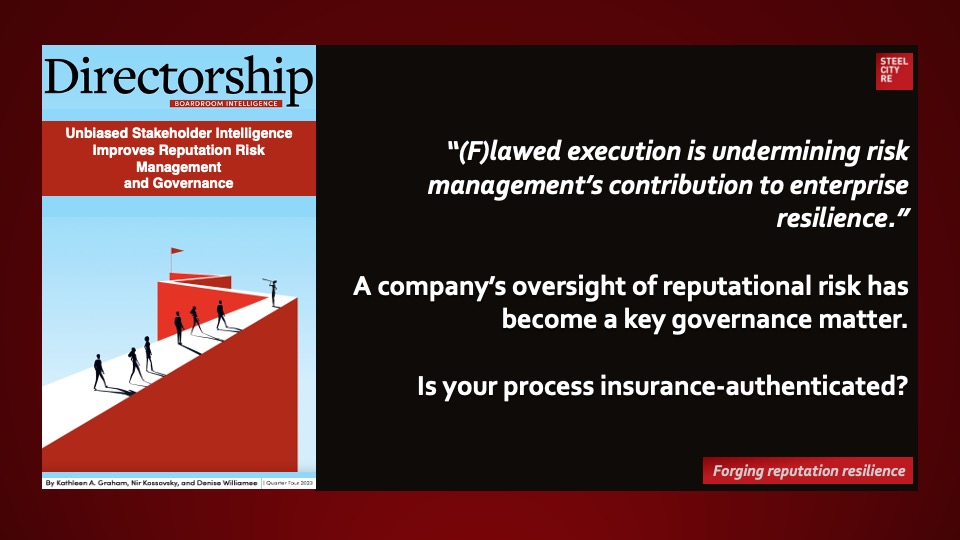
Personal attacks on directors are now a governance weapon – amplified by activists, media, and social platforms. Traditional protections (proxy advisors, board slates, collegiality) are eroding. Reputational harm can drive board turnover, litigation, and long-term career damage. Emerging responses: (1) Hazard pay for directors; (2) Reputation insurance alongside D&O coverage. Oversight of reputational risk is mission-critical. Boards must exercise foresight: how is reputational risk being integrated into risk management, who is responsible, and how is the company mitigating it?

February 20, 2025

“The worst thing that can happen to a company is: You’re still on that list, but you’ve lost all your good faith and credibility with folks on the other side of these issues.” We call this situation a reputation crisis and a clear need for reputation insurance.

There are 45 companies (combined value $10 trillion) on the MAGA anti-DEI hit list.“The worst thing that can happen to a company is: You’re still on that list, but you’ve lost all your good faith and credibility with folks on the other side of these issues.” We call this situation a reputation crisis and a clear need for reputation insurance.

December 4, 2024

Governance experts including the National Association of Corporate Directors and other authorities are encouraging boards to support management more closely in an "uncertain — and possibly volatile — environment," even at the risk of appearing to micromanage. But with engagement comes culpability for the reactions of already-angry stakeholders. Simply put, the costs of leaning into a reputation crisis may include the dispensation of board members whose personal losses will not be covered by D&O liability insurance. Board members need personal reputation insurance.

Governance experts including the National Association of Corporate Directors and other authorities are encouraging boards to support management more closely in an “uncertain — and possibly volatile — environment,” even at the risk of appearing to micromanage. But with engagement comes culpability for the reactions of already-angry stakeholders. Simply put, the costs of leaning into a reputation crisis may include the dispensation of board members whose personal losses will not be covered by D&O liability insurance. Board members need personal reputation insurance.

September 14, 2024

Boeing employees are striking for…more input into product safety. This labor action is a manifestation of lost reputation value. This labor action is a stark reminder that angry, disappointed employees are one of many expressions of a reputation crisis. Corporate leadership and governors must be mindful that that the long tail of reputation risk typically includes costly investor, regulator, and yes, employee actions.

Boeing employees are striking for…more input into product safety. This labor action is a manifestation of lost reputation value. This labor action is a stark reminder that angry, disappointed employees are one of many expressions of a reputation crisis. Corporate leadership and governors must be mindful that that the long tail of reputation risk typically includes costly investor, regulator, and yes, employee actions.

September 12, 2024

Reputation Risk Hinted by Nickname Nurse Death

Reputation risk arises from the failure to meet expectations. All too frequently, reputation risks arising from material operational problems known to insiders are dismissed by those in charge or authority. Nicknames can indicate an issue with ethics, innovation, safety, security, sustainability, and quality. “Junior doctors were referring to Lucy Letby as “Nurse Death” … two years before she was arrested. […] Letby, 34, was sentenced to 15 whole-life orders after she was convicted across two trials of murdering seven babies and attempting to murder seven others.” Board members should note that there are many windows into human resource-based organizational risk.

August 19, 2024

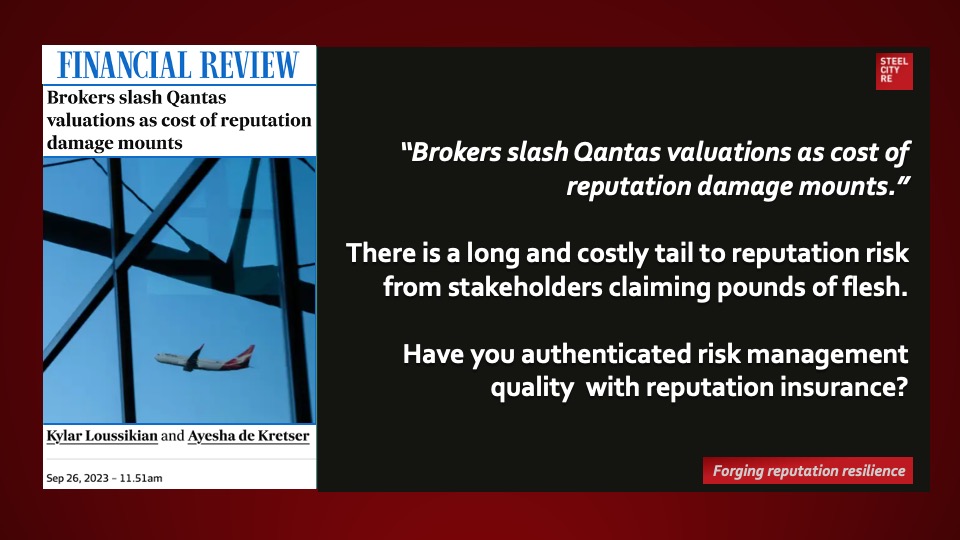
Investors are not good at predicting the net impact of reputation risk. They tend to over or underestimate the net impact on future cash flows on the basis of sentiment and noise rather than on indicators of stakeholder disaffection and behavioral change such as those integral to Steel City Re's premier reputation risk prediction tool, its Resilience Monitor.

Investors are not good at predicting the net impact of reputation risk. They tend to over or underestimate the net impact on future cash flows on the basis of sentiment and noise rather than on indicators of stakeholder disaffection and behavioral change such as those integral to Steel City Re’s premier reputation risk prediction tool, its Resilience Monitor.